Author Sara Paretsky at Barrington’s White House
By Mary Klest
Sara Paretsky’s unforgettable character V.I. Warshawski along with twisted plots, intriguing settings and social commentary landed her on the New York Times best seller list. Her fearless female private investigator first appeared in Paretsky’s debut novel Indemnity Only in 1982. That launched a crime series that includes 22 books, the most recent being Pay Dirt.
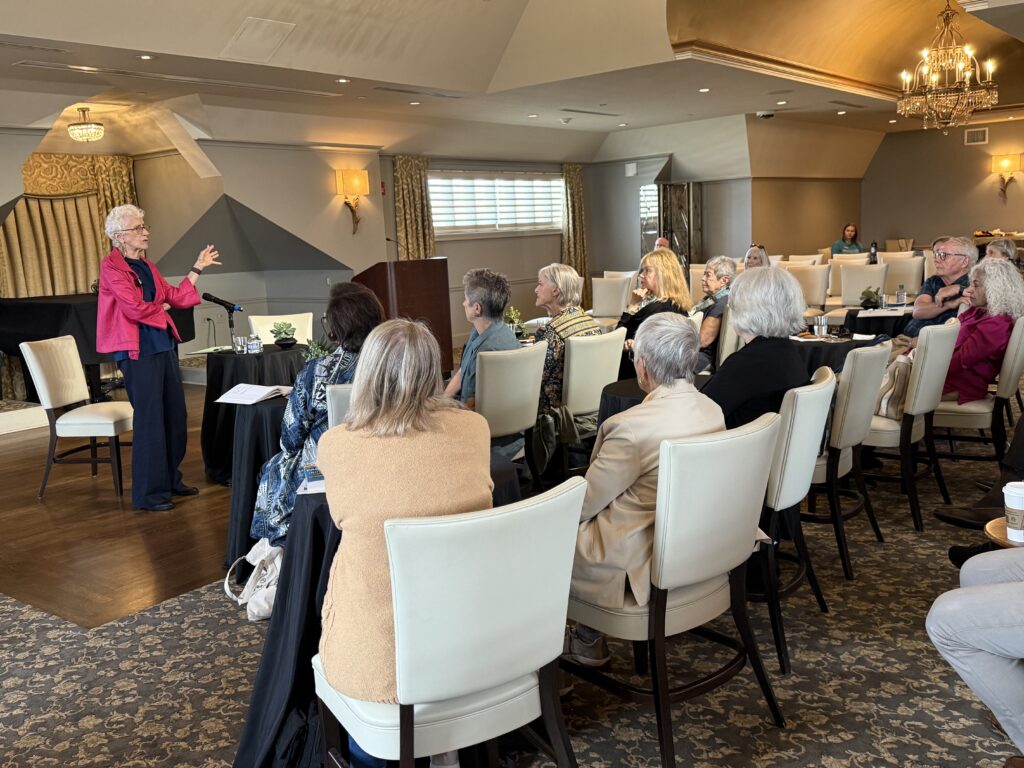
Paretsky revealed her current work in progress features a different female protagonist named Lilly. What? The announcement was just one of many candid moments. Below are questions posed by BWW members during the Q&A, based on my notes and recollection.
BWW: Do you know how your book will end when you begin to write?
No. She knows the crime and some of the details, but not the ending. She lets that unpack itself as the story grows.
BWW: You wrote in a blog post that your characters take control and you bring them to life. What did you mean?
Paretsky laughed as she explained how a side character can become more important than she had originally conceived. She shared some examples from her books. Her real-life acquaintances may slip into her fiction as poignant characters.
BWW: Do you set up plot points?
No, instead she keeps track of her characters and chapters with artist sketch pads. “I’m like a tennis player who waits for the ball to come to me.” Her recent books are longer, with more intricate plots. “I’m a slow thinker and fast writer,” she said. In between novel writing she writes short stories.
BWW: What is your edit and review process like?
She described it as a meticulous and time consuming process. It lets her know when a story is not working. Her late husband had always been her first reader. She misses his support. For one book, she cut 200 pages during the review process. She added: “It’s hard to get the language right. Using contemporary slang will date the book.”
BWW: Do you have a favorite of your books?
She favors her third book, Killing Orders, inspired by her grandmother’s immigrant story. She also favors her 13th book, HardBall as it is based on her first summer in Chicago that she said changed her life. She admitted: “All my books have strengths and weaknesses.”
BWW: Where do you find ideas for the crimes in your stories?
She draws from her experience working at insurance company CNA. She keeps an eye on contemporary stories, focusing on white-collar crime. One crime story grew out of a Wall Street Journal case she found compelling.
BWW: Do you have relationships with cops, detectives?
Some, but her focus is white collar financial crime. “If I don’t understand it, I won’t write it.” She described her work as fantasy, not how-to. She once created an imaginary country for a book rather than risk inaccuracies about a real one.
BWW: Is there a particular day or time you write?
She once thrived writing between 8:00pm and midnight but sleep issues may change that routine.
BWW: What authors do you like to read?
She praised Hilary Mantel’s Wolf Hall as “a perfect novel.” She also mentioned George Elliot, Jane Austen, and Louisa May Alcott among her favorites.
From Process to Principle
In contrast to the informality of the BWW session, Sara Paretsky’s public talk was carefully crafted. Reading from prepared notes, she began with her writing process, then moved to the influence of culture on a writer’s ability to remain true to their work.
Paretsky spoke passionately about the importance of free expression. She warned against censorship, recrimination, and intimidation. She stayed in her lane as a writer, delivering thoughtful, reasoned ideas. She talked about the impact book banning in libraries has on writers and cautioned against the danger of self-censorship. What harms a writer’s voice can harm all of society by limiting the free flow of ideas.
During these polarized times, I worried that her comments might offend someone in the audience. But when Sara Paretsky finished her talk, applause filled the room and the audience rose in a standing ovation. It was as if they had been waiting for someone to say what they themselves were thinking.
It reminded me of what courage it takes to be a writer.
###
“Listening to Sara Paretsky’s insights about her writing process was like having a seat in a master class. Her candor and forthcoming anecdotes about storytelling – including the nuts and bolts of her practice – were delightful, endearing and inspirational.” – Vicki Atkinson, BWW member
“I thoroughly enjoyed both parts of Sara Paretsky’s presentation. Her remarks were engaging and energizing to me. On the topic of free speech, I found her remarks both hopeful and brave. She spoke her truth clearly without getting political or resorting to name calling. I was glad I attended.” – Trudy Kleckner, BWW member